

Phase 3 depth guide
A personal loan is a sum of money you borrow from a bank or licensed financial institution, which you repay in monthly instalments over a fixed period. As an unsecured loan, you do not need to pledge collateral, though some lenders may require a guarantor if your income or credit history does not meet their standard criteria.
Personal loans are commonly used for education, home renovation, debt consolidation, medical expenses, or unexpected cash needs. Both conventional and Islamic personal financing products are available, each with its own rate structure and terms.
What to compare before you borrow
A headline interest rate tells only part of the story. Before applying, work out the total repayment amount by multiplying the monthly instalment by the number of months and adding any upfront fees. Compare the effective interest rate (EIR), which reflects the true annual cost after accounting for how the rate is calculated and applied.
Tenure matters: shorter tenures mean higher monthly payments but significantly less total interest. Check early settlement terms, because some banks charge a fee or reduce the rebate on remaining interest if you pay off the loan ahead of schedule. Optional insurance or takaful cover that settles the outstanding balance on death or total permanent disability will increase the total borrowing amount.
Conventional vs Islamic personal loans
Conventional personal loans operate on a lender-borrower relationship where the bank charges interest on the loan amount. Islamic personal financing follows Shariah-compliant contracts such as Murabahah, Musyarakah, or Bai al-Inah, using a buyer-seller relationship with a profit rate instead of interest. In Islamic financing, profit does not compound when payment is overdue, and the bank shares some risk in earning returns.
The total cost of both products is usually similar. Islamic financing is not inherently more expensive — many Islamic banks quote competitive profit rates that compare favourably with conventional interest rates. The structure differs, not the economics.
How banks calculate personal loan interest
Most Malaysian banks use a flat rate method. The percentage is applied to the original loan amount for every year of the tenure, regardless of how much principal you have already repaid. For example, RM20,000 at 6% flat rate over 5 years produces RM6,000 in flat interest, RM26,000 total repayment, and RM433.33 per month.
Because you are paying interest on the full RM20,000 even as the balance drops to RM10,000 halfway through, the effective interest rate is roughly double the flat rate — around 11% to 12% per annum. Banks prefer this method because it keeps monthly payments the same and is simple to explain.
The 2027 regulatory change
Bank Negara Malaysia has announced that the flat rate method and the Rule of 78 will be prohibited for personal financing products from 1 January 2027. All new agreements will use the reducing balance method, where interest is calculated on the outstanding principal each month.
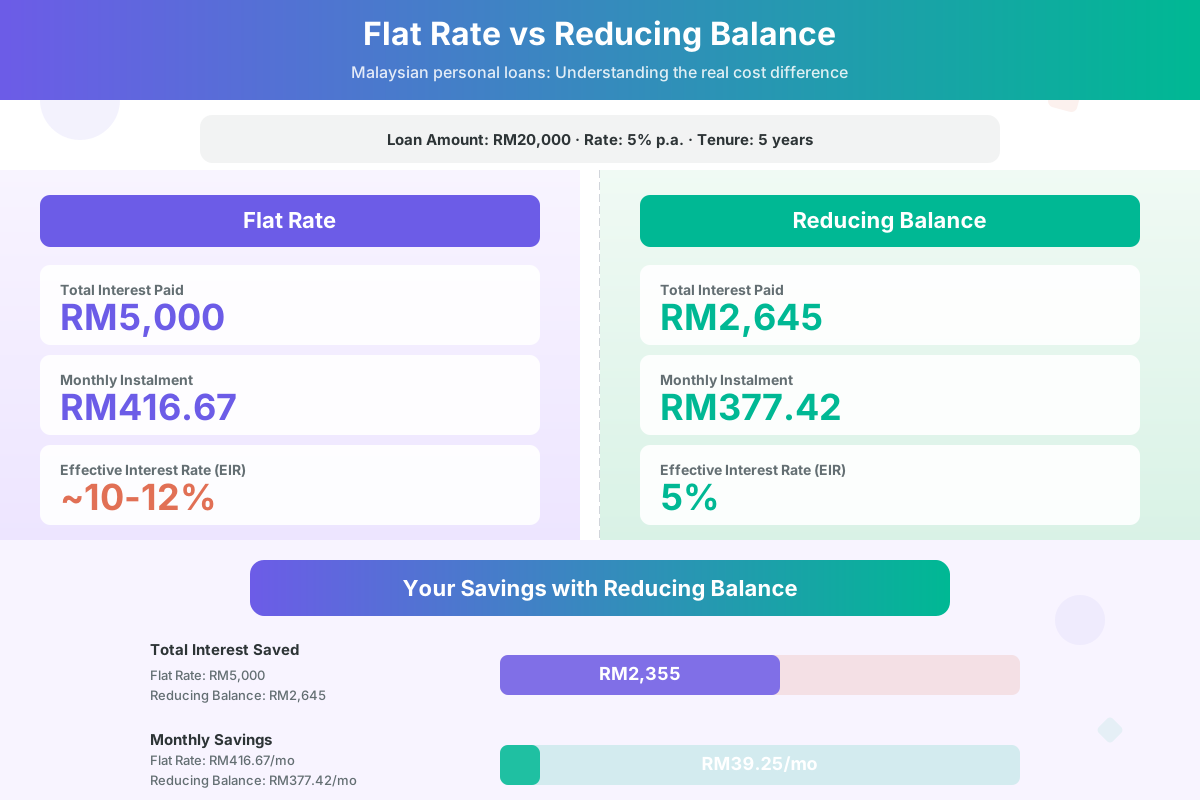
On a RM20,000 loan at 5% p.a. over five years, the difference is substantial. Under flat rate, total interest is RM5,000 with a monthly instalment of RM416.67. Under reducing balance, total interest drops to RM2,645 and the monthly instalment falls to RM377.42. The EIR matches the advertised rate under the new method, whereas under flat rate it is roughly double.
What affects your personal loan rate
Banks consider four main factors when pricing a personal loan: credit score (a three-digit number from agencies like CTOS or CCRIS, with scores above 718 viewed as prime), debt service ratio (the percentage of gross monthly income already committed to debt repayments, capped at 60% by most banks), loan amount, and tenure.
Employment type matters too. Government and GLC employees typically receive preferential rates because salary deduction through Biro Perkhidmatan Angkasa reduces the lender's risk. Self-employed applicants usually need to provide six to twelve months of bank statements and latest tax filings.
How to check your eligibility before applying
A rejected application leaves a credit inquiry on your CCRIS record. Multiple rejections in quick succession make the next one harder. Before submitting anything, check your CCRIS report for free via BNM's eCCRIS portal and review your CTOS score at ctoscredit.com.my.
Calculate your DSR by dividing total monthly commitments by gross monthly income and multiplying by 100. If the result is between 60% and 70%, most banks will decline your application. Gather your documents first — salaried employees need MyKad, three months of payslips, EA form or EPF statement, and salary bank statements. Apply to one bank at a time and wait for the result before trying another.
Common personal loan misconceptions
Banks do check your bank statement, but they look for income consistency, bounce history, and existing loan deductions — not whether you bought nasi lemak at the mamak stall. Gambling transactions and large cash withdrawals that do not match your stated income are red flags; regular spending on groceries, subscriptions, and dining is not.
Applying to multiple banks within a short period often backfires because each application leaves a credit inquiry. A RM15,000 salary does not guarantee approval if existing commitments push your DSR over 60%. Government jobs help but do not guarantee approval — DSR and credit history still matter. Islamic loans are not always more expensive; many Islamic banks quote competitive profit rates.
Comparison worksheet
| Metric | Flat rate (current) | Reducing balance (from Jan 2027) |
|---|---|---|
| Interest calculated on | Full RM20,000 throughout | Remaining balance each month |
| Total interest paid | RM5,000 | RM2,645 |
| Monthly instalment | RM416.67 | RM377.42 |
| EIR vs advertised | EIR roughly double the flat rate | EIR matches the advertised rate |
Frequently asked questions
What is the minimum salary to apply?
Most banks require RM2,000 per month for salaried employees. Government and GLC staff can qualify from RM1,500. Self-employed applicants generally need RM3,000 to RM4,000 per month.
Can I get a personal loan with bad credit?
Yes, but expect higher rates and fewer options. Clear any errors on your CCRIS report first — disputes are common.
How long does approval take?
Most banks decide within one to three working days for complete applications. Digital lenders may approve on the same day. Disbursement takes a further two to five working days.
What is the difference between a personal loan and personal financing?
A personal loan uses conventional banking (lender-borrower, interest-based). Personal financing uses Shariah-compliant Islamic banking (buyer-seller, profit-based). The math is often similar.
What happens if I cannot make a payment?
Contact your bank first — they may restructure the loan with lower instalments. Alternatively, AKPK provides free counselling and can enrol you in their Debt Management Programme (DMP), where they negotiate with your creditors on your behalf.
How does debt consolidation work?
Multiple debts like credit cards and older loans can be consolidated into a single personal loan. Credit cards typically charge 15% to 18% p.a. while personal loans start well below that. On a RM30,000 balance, consolidating into a five-year personal loan at 5% p.a. could save roughly RM10,000 in interest compared to carrying the credit card balance.
Sources
- RINGGITPLUS
Maklumat pendidikan sahaja. Kandungan ini bukan nasihat kewangan, undang-undang, cukai, insurans atau Syariah dan tidak meramalkan kelulusan.